Wilmington, DE, United States, Sept. 09, 2026 (GLOBE NEWSWIRE) -- Cargo Handling Infrastructure Emerging as a Strategic Control Point across Global Trade Networks
Port infrastructure has shifted from being a logistical utility to a strategic asset that determines which trade corridors compress costs and which fall behind. The cargo handling equipment market sits at the center of this realignment, where decisions made by terminal operators today set throughput economics for the next two decades. A meaningful share of operators have not yet absorbed how quickly the equipment procurement calculus is changing beneath them.
What appears as a steady replacement cycle is, on closer inspection, a structural reordering of how ports compete. Electrification mandates, automation economics, and the rise of mega-vessels are collapsing the timeline for fleet renewal. Operators treating this as a routine capex agenda are now bidding for slots against operators treating cargo handling capability as a strategic moat, and the procurement window for differentiated equipment is measurably narrowing.
Request a Free Sample Report: https://marketmindsadvisory.com/request-sample/?report_id=47
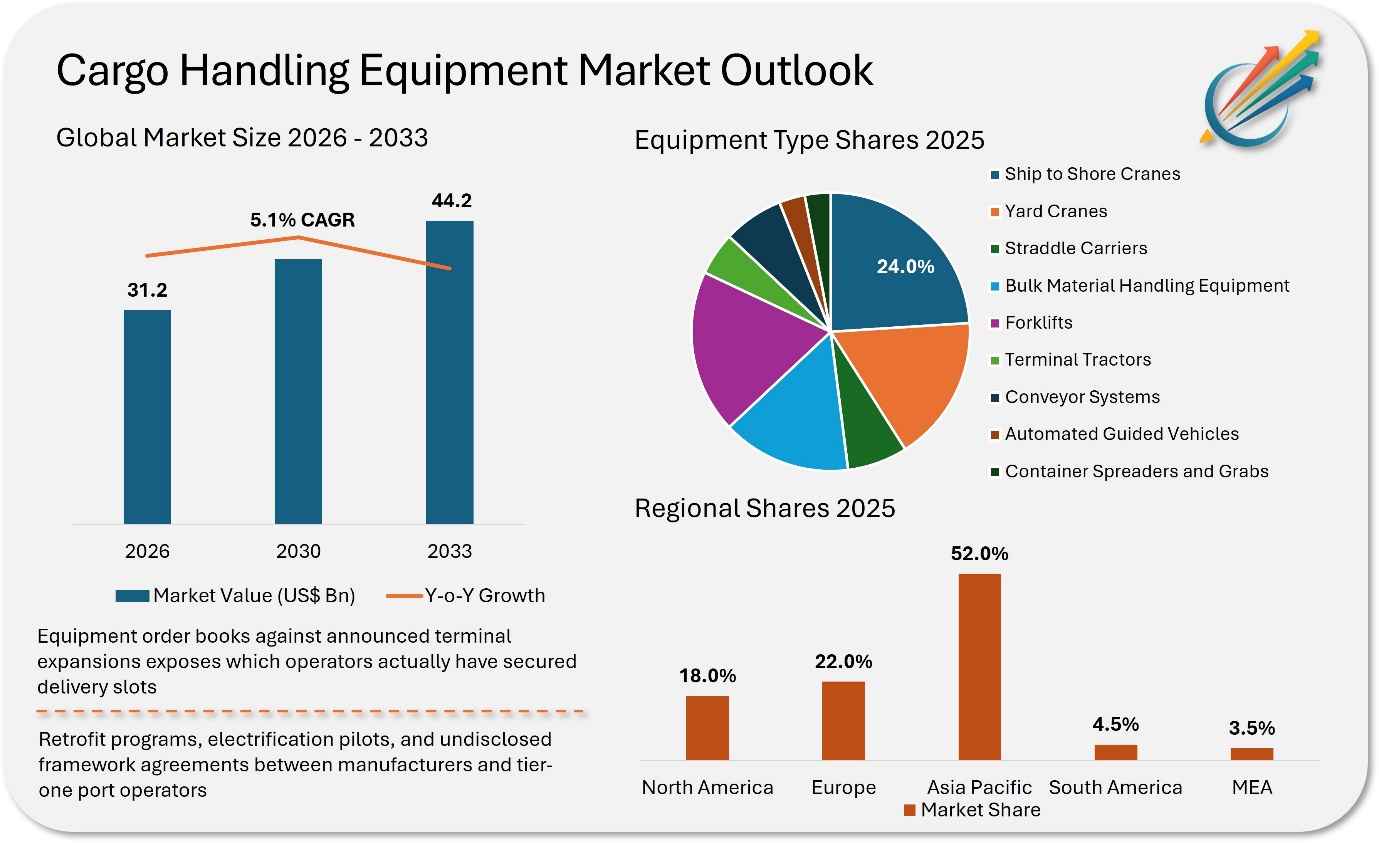
Key Takeaways from Cargo Handling Equipment Market
- Global cargo handling equipment market valued at US$ 31.2 billion in 2026, on track to reach US$ 44.2 billion by 2033. Cargo handling equipment market expanding at a CAGR of 5.1% between 2026 and 2033, driven by automation and electrification
- Electric and hybrid propulsion units are projected to surpass diesel orders in container terminals in the cargo handling equipment market
- Ship-to-shore crane lead times have stretched past 36 months at leading manufacturers
- Asia-Pacific accounts for the majority of new equipment orders, led by Chinese and Southeast Asian port expansions
- Automated guided vehicles and remote-controlled cranes are reshaping labor economics at greenfield terminals in cargo handling equipment market
- Retrofit and electrification of existing fleets is emerging as a parallel revenue stream rivaling new equipment sales
As per Lead Analyst from Market Minds Advisory, " The cargo handling equipment market has crossed from cyclical replacement into structural transformation, and the operators securing electric and automated fleet capacity in the next 18 months will hold a measurable cost advantage. Procurement timing, not procurement price, is now the binding constraint."
A Narrow Procurement Window is Opening for Port Operators still Delaying Modernization
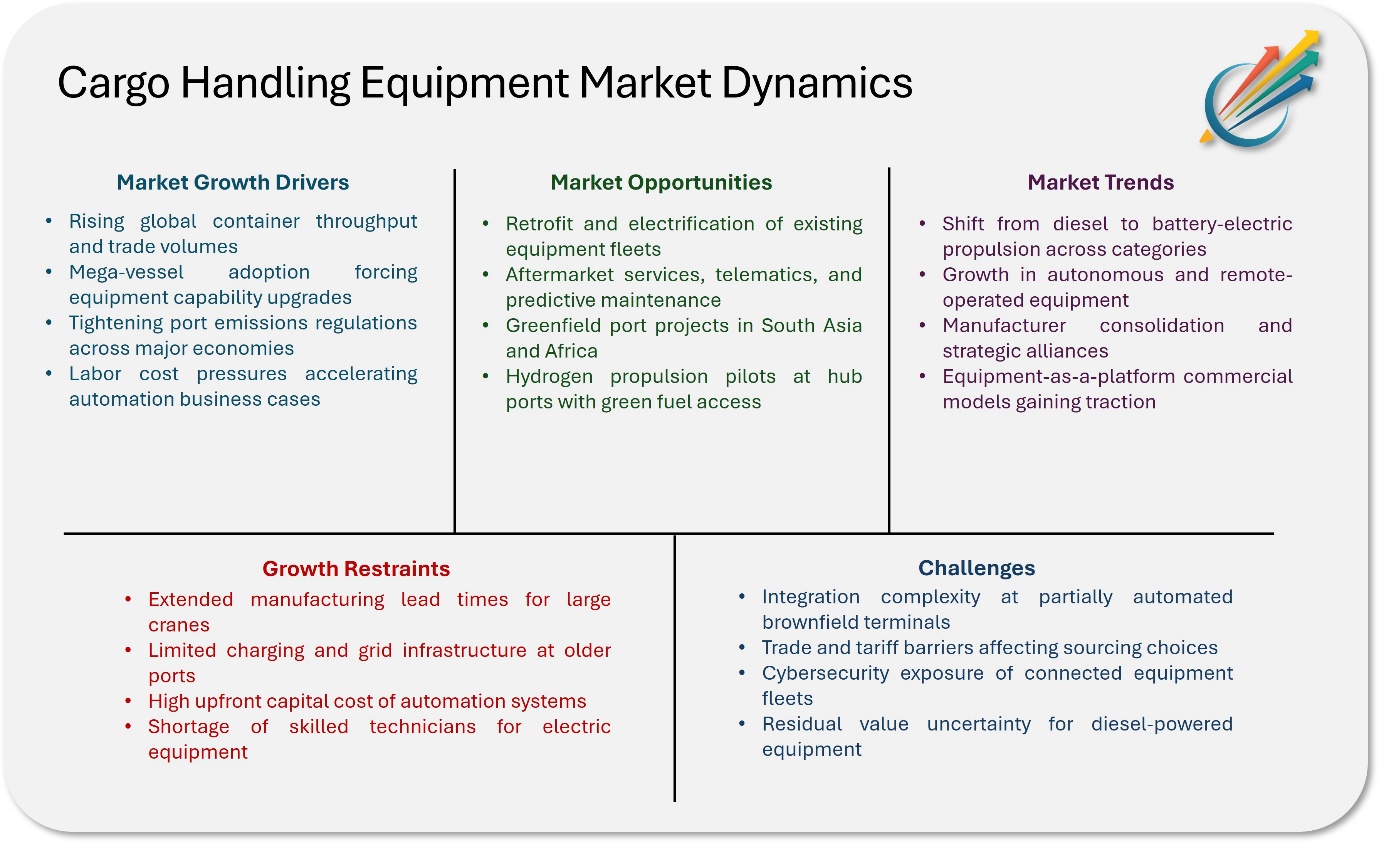
The cargo handling equipment market is moving through a procurement bottleneck that few operators have priced into their capital plans. Three forces are converging at once.
- Lead times have decoupled from historical norms: Ship-to-shore crane manufacturers are quoting delivery windows that exceed three years, a structural break from pre-pandemic patterns that reshapes how terminal expansion is sequenced.
- Electrification timelines are compressing: Port authorities in Europe and North America are tightening emissions rules faster than diesel fleet depreciation schedules anticipated, forcing accelerated write-downs and earlier replacement decisions.
- Automation premiums are stabilizing: The cost gap between manual and automated terminal handling is narrowing, and the operators who hesitated on AGV deployment are now confronting capability gaps that take years to close.
Equipment Availability is Quietly Becoming More Critical than Terminal Expansion Plans
For decades, equipment specification followed terminal design. That sequence has reversed. Equipment availability now constrains what terminals can credibly plan to handle.
- Manufacturer slot allocation is becoming a competitive variable: Leading ports are securing multi-year framework agreements with crane and AGV makers, locking out smaller operators from premium delivery windows and skewing capacity additions toward already-dominant hubs.
- Mega-vessel economics are forcing equipment specification upgrades: Container ships above 24,000 TEU require ship-to-shore cranes with longer outreach and heavier lift capacity, rendering large portions of installed equipment functionally obsolete despite remaining mechanical life.
- Propulsion choice is becoming a stranded-asset question: Diesel terminal tractors and forklifts ordered today may face restricted operating windows within their depreciation cycle, and the cargo handling equipment market is repricing residual value accordingly.
The Cargo Handling Equipment Market is Moving Faster than Port Investment Models Anticipated
Hydrogen fuel cell equipment will remain a niche category through 2030, despite the volume of pilot announcements. Battery-electric platforms are scaling faster, infrastructure costs are clearer, and the operating economics for most port duty cycles favor electric over hydrogen at current price points.
The retrofit and electrification services segment will outgrow new equipment sales in mature markets. Existing fleets in Europe and North America represent a larger near-term revenue pool than greenfield orders, and manufacturers without credible retrofit offerings will cede share to specialized integrators.
Chinese manufacturers will capture a larger share of premium ship-to-shore crane orders outside Asia than current Western competitive positioning assumes. Cost, delivery reliability, and improving technology specifications are eroding the historical preference for European-built equipment at price-sensitive terminals.
A New Competitive Structure is Emerging across the Port Equipment Ecosystem
Electrification of Port Fleets
The shift from diesel to electric propulsion is no longer a sustainability statement. It is a procurement reality. Terminal tractors, reach stackers, and forklifts are transitioning to battery-electric platforms at a pace that is outrunning charging infrastructure rollouts in many regions, creating a temporary advantage for operators who invested in grid capacity ahead of mandates rather than alongside them.
Automation and Remote Operations
Automated guided vehicles and remote-controlled cranes are redefining the labor cost structure at container terminals. The cargo handling equipment market is bifurcating between fully automated greenfield terminals and brownfield operations attempting partial automation, with the latter facing integration costs that often exceed initial estimates. Operators with clean automation roadmaps are capturing throughput gains that compound annually.
Digital Twin and Predictive Maintenance Integration
Equipment is increasingly sold as a platform rather than a unit. Sensors, telematics, and predictive maintenance subscriptions now contribute meaningful aftermarket revenue for major manufacturers, and the operators leveraging this data effectively are reducing unplanned downtime by margins that meaningfully alter terminal economics.
Consolidation among Equipment Manufacturers
The supplier landscape is tightening. Mid-tier manufacturers are being acquired, joint ventures are forming around electrification and automation capability, and the cargo handling equipment market is moving toward a structure where fewer than ten players control the majority of premium equipment categories. Buyers underestimating this concentration risk are exposing themselves to future pricing power shifts.
Ignoring Structural Risks Could Delay Competitive Readiness across Global Trade Corridors
- Grid capacity constraints: Electrification of port fleets requires substantial substation upgrades that many port authorities have not yet funded or sequenced.
- Workforce skill gaps: Automated and electric equipment demands technician profiles that current training pipelines are not producing at scale.
- Supply chain concentration: A small number of facilities globally produce the largest ship-to-shore cranes, creating single-point delivery risks.
- Trade policy volatility: Tariffs and procurement restrictions targeting specific manufacturer geographies are reshaping sourcing decisions and lengthening evaluation cycles.
- Financing pressure: Higher interest rates are extending payback calculations on automation investments at second-tier terminals.
- Cybersecurity exposure: Connected equipment fleets are expanding the attack surface at critical port infrastructure, drawing regulatory scrutiny.
These risks are real and material, but none of them reverse the directional conclusion. They reshape pace and sequence, not destination.
Market Dynamics Shaping the Cargo Handling Equipment Market
Cargo Handling Equipment Market Segmentation
By Equipment Type
- Ship to Shore Cranes
- Yard Cranes
- Straddle Carriers
- Bulk Material Handling Equipment
- Forklifts
- Terminal Tractors
- Conveyor Systems
- Automated Guided Vehicles
- Container Spreaders and Grabs
- Others
Ship-to-shore cranes anchor the high-value end of the cargo handling equipment market, with order books concentrated among a small number of global manufacturers. Forklifts and terminal tractors generate the largest unit volumes and are leading the electric propulsion transition. Automated guided vehicles represent the fastest-growing category in value terms, particularly at greenfield container terminals. Conveyor systems and bulk material handling equipment retain strong demand in dry bulk and mining-linked ports.
By Payload Capacity
- Ultra Light Capacity (≤ 5 Ton)
- Light Capacity (5–15 Ton)
- Moderate Capacity (15–50 Ton)
- Heavy Capacity (50–150 Ton)
- Ultra Heavy Capacity (> 150 Ton)
Moderate and heavy capacity equipment categories command the largest revenue share, reflecting their central role in container and breakbulk handling. Ultra heavy capacity units are tied closely to mega-vessel servicing and project cargo movements, and their order patterns track major port expansion announcements. Light and ultra light categories dominate warehousing and inland logistics applications, with the cargo handling equipment market seeing rapid electrification at this end of the spectrum.
By Cargo Type
- Containerized Cargo
- Dry Bulk Cargo
- Liquid Bulk Cargo
- Breakbulk and Project Cargo
- RoRo Cargo
- Palletized Cargo
- Refrigerated Cargo
- Hazardous Materials
- Others
Containerized cargo handling drives the bulk of equipment investment globally, but specialized segments are outgrowing the base rate. RoRo cargo handling is expanding with electric vehicle exports, refrigerated cargo equipment is scaling with cold chain trade, and hazardous materials handling carries premium equipment specifications. Dry and liquid bulk segments remain capital-intensive and tightly linked to commodity cycles, sustaining steady demand for specialized cargo handling equipment.
By Propulsion Type
- Diesel Powered Equipment
- Electric Powered Equipment
- Hybrid Powered Equipment
- Hydrogen Fuel Cell
Electric propulsion is the defining structural shift across the cargo handling equipment market. Battery-electric platforms are reaching cost parity with diesel in most duty cycles, and hybrid units are serving as transition technology where charging infrastructure remains immature. Hydrogen fuel cell equipment remains in pilot phase, with deployment concentrated at hub ports with access to green hydrogen supply. Diesel retains share in heavy and ultra heavy categories where electrification economics are still being proven.
By End User
- Port and Terminal Operators
- Shipping Lines and Container Operators
- Freight Forwarders and Logistics Providers
- Rail Operators and Intermodal Terminals
- Warehousing and Distribution Centers
- E-Commerce
- Manufacturing & Industrial Plants
- Mining Companies
- Oil and Gas Companies
- Construction & Infrastructure Contractors
- Military and Defense Logistics
Port and terminal operators account for the largest share of cargo handling equipment market demand, followed by warehousing operators driven by e-commerce expansion. Shipping lines are increasingly investing directly in terminal equipment through vertical integration strategies. Mining, oil and gas, and industrial end users sustain specialized equipment categories, while defense logistics represents a small but resilient segment with distinct procurement cycles.
Shape this report around your priorities: https://marketmindsadvisory.com/request-customization/?report_id=47
Regional Market Outlook
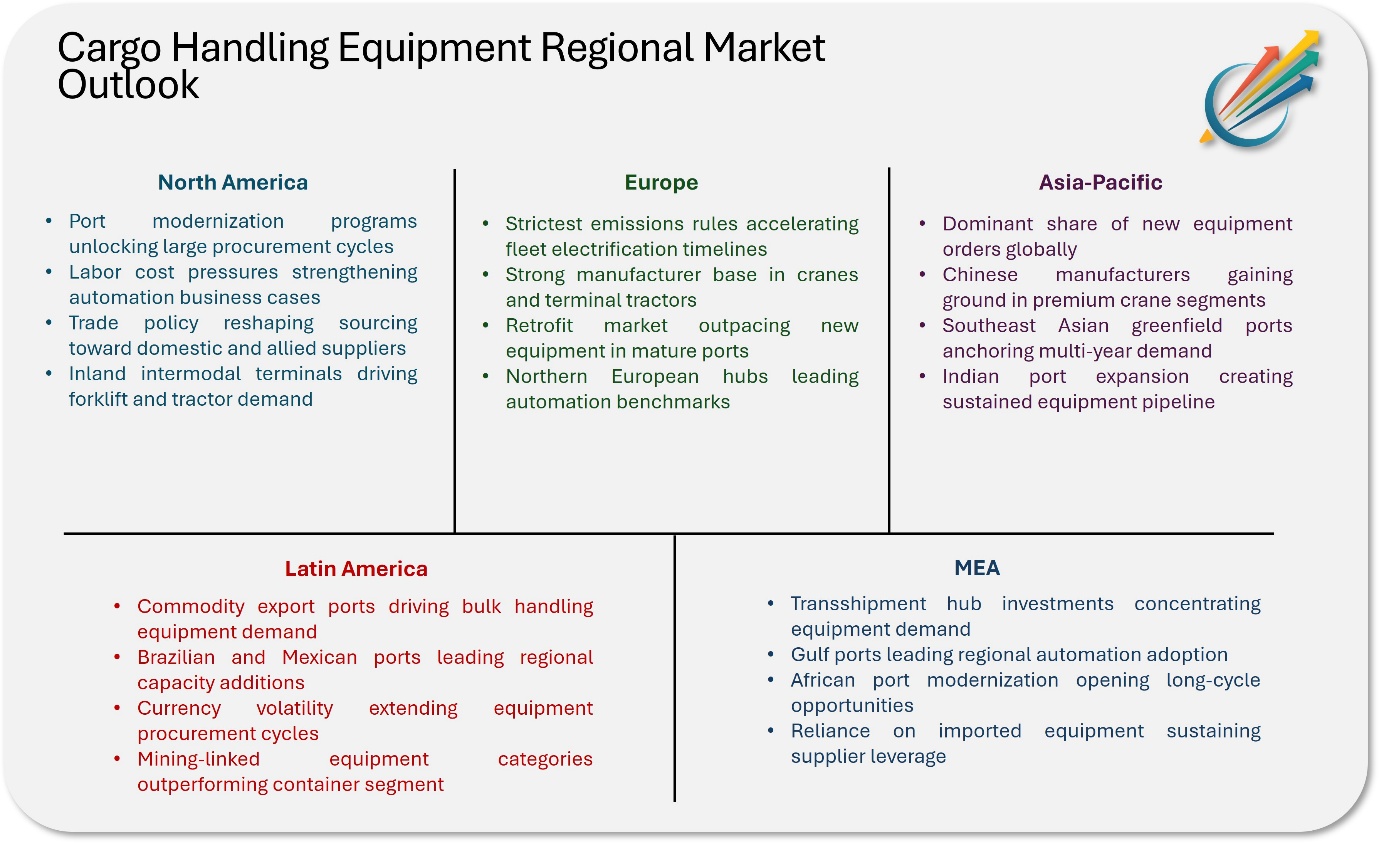
Investment Focus where the Lucrative Opportunity is Anticipated
Electrification and Retrofit Services
The largest near-term value pool in the cargo handling equipment market sits in converting existing diesel fleets to electric and hybrid propulsion. Manufacturers and integrators with credible retrofit programs are capturing recurring revenue at margins that often exceed new equipment sales, particularly in regulated European and North American port environments.
Automation Integration at Brownfield Terminals
Greenfield automation gets the headlines, but the harder and more defensible opportunity is integrating automated systems into operating terminals without disrupting throughput. Players with proven integration capability command pricing power, and the cargo handling equipment market is rewarding execution track record over technology novelty in this segment.
Aftermarket and Predictive Maintenance Platforms
Equipment is becoming a recurring revenue platform. Manufacturers building telematics, predictive maintenance, and parts subscription businesses are capturing margins that smooth the cyclicality of new equipment sales. This shift favors players with installed bases large enough to support meaningful data assets.
Specialized Equipment for Energy Transition Cargo
Wind turbine components, electric vehicle exports, and battery materials require specialized handling capability. Manufacturers positioning early in heavy lift, RoRo, and hazardous materials equipment categories are aligned with structurally growing cargo flows that command premium handling rates and longer equipment service lives.
What This Means for Decision-Makers
Port & Terminal Operators - Equipment procurement timing has become a strategic lever, not a back-office function. Operators who secure delivery slots and electrification roadmaps in the next 18 months will hold a measurable cost advantage in the cargo handling equipment market through the next decade.
Equipment Manufacturers - The competitive boundary is moving from product specification to integrated service delivery. Manufacturers without credible retrofit, telematics, and aftermarket offerings will cede share to players treating equipment as a platform rather than a transaction.
Investors - The investment thesis has matured past pure cyclical exposure. Aftermarket services, electrification retrofit, and automation integration represent defensible positions with clearer recurring revenue profiles than pure new equipment plays in the cargo handling equipment market.
Policymakers - Port competitiveness now hinges on grid capacity, workforce reskilling, and procurement coordination. Jurisdictions that align emissions mandates with infrastructure investment and training pipelines will retain trade share, while those mandating outcomes without enabling capability will see investment migrate elsewhere.
Competitive Landscape: Cargo Handling Equipment Market
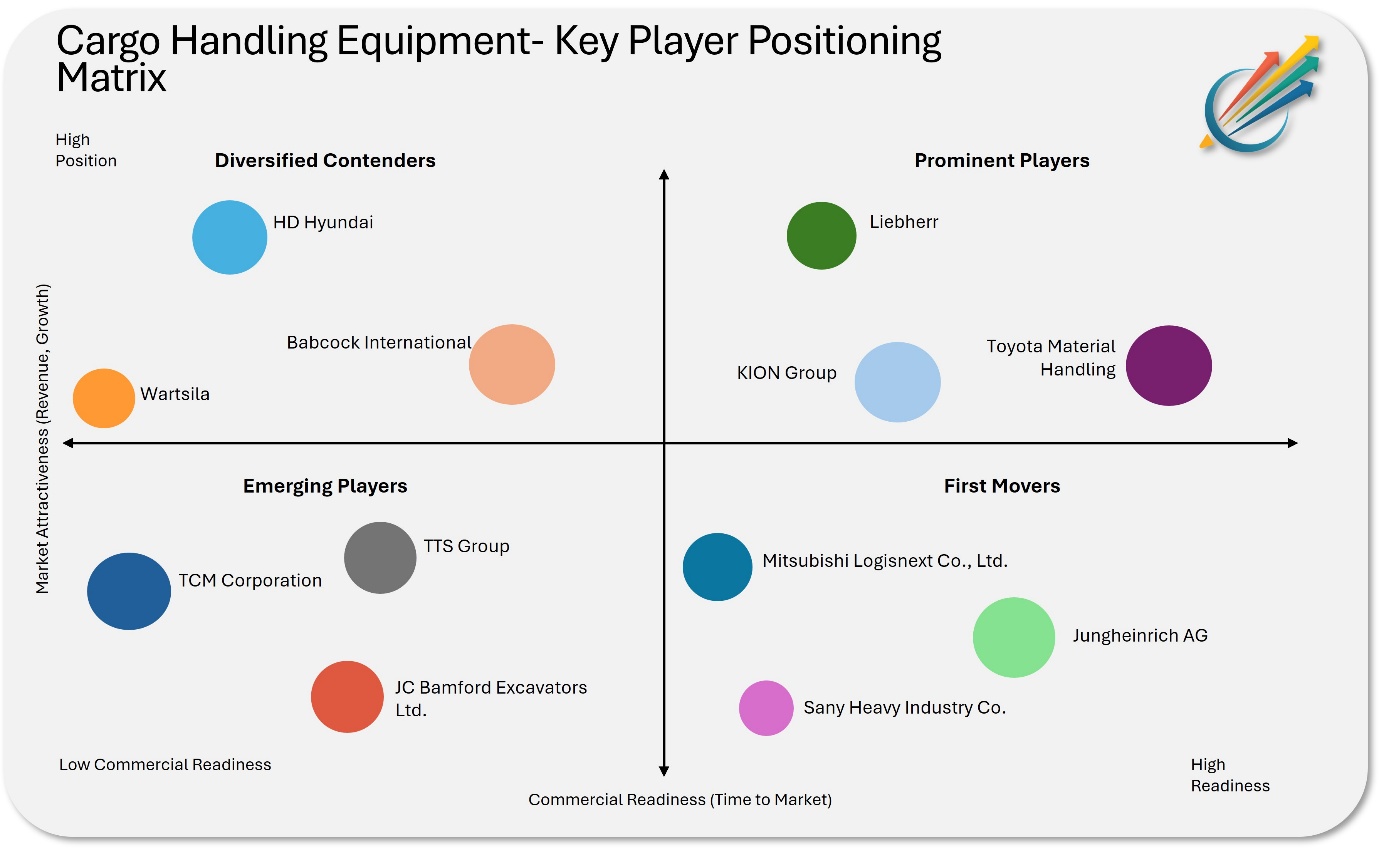
Recent Market Developments
- In March 2026, Konecranes Oyj announced an expansion of its hybrid and electric reach stacker production capacity in response to accelerating port electrification orders.
- In February 2026, Kalmar Corporation introduced an updated range of battery-electric terminal tractors targeted at North American and European port operators.
- In January 2026, Shanghai Zhenhua Heavy Industries secured additional ship-to-shore crane orders linked to Southeast Asian container terminal expansions.
- In December 2025, Liebherr announced upgrades to its mobile harbor crane portfolio focused on hybrid propulsion and digital monitoring capabilities.
Get Access to complete Analysis, Buy Now: https://marketmindsadvisory.com/buy-now/?report_id=47
Trending Reports
- Diagnostic Vials Market
- Digital Folding Cartons Market
- Degassing Valves Market
- Cryogenic Vials and Tubes Market
- Insulated Shipping Boxes Market
- Cryogenic Capsules Market
- Cosmetic Dropper Market
- Corrugated Mailers Market
- Corrugated Fanfold Market
- Cling Film Market
Why choose Market Minds Advisory
Market Minds Advisory delivers decision-grade intelligence to executives across machinery, packaging, chemicals, automotive, ICT, food and beverage, consumer goods, and healthcare. We help organizations sharpen market expansion strategies, accelerate share gains, refine brand positioning, and enable account-level growth. Our forecasting integrates primary interviews, proprietary demand models, and continuous market validation, producing the kind of clarity volatile and emerging industries require. Backed by over a decade of sector expertise, our research surfaces white space, opportunity gaps, and competitive blind spots, accounting for recent developments and geopolitical risk. We help businesses see the future of their markets.
Contact Us
Market Minds Advisory
1521 Concord Pike, Suite 301
Wilmington, DE 19803
United States
Email: sales@marketmindsadvisory.com
Website: https://marketmindsadvisory.com/