
Amazonian & Andean Healing at Blue Morpho: Two Sacred Medicines, One Integrated Path
Iquitos, Peru - May 6, 2026 / Blue Morpho /
Iquitos, Peru–A growing number of people are turning to traditional ceremonial healing practices as an alternative path for mental and emotional well-being. Amid this shift, Blue Morpho, a long-established shamanic healing center based in the Peruvian Amazon, continues to draw attention for its two-medicine ceremonial model, which pairs traditional Amazonian and Andean healing practices within a single, sequenced retreat program.
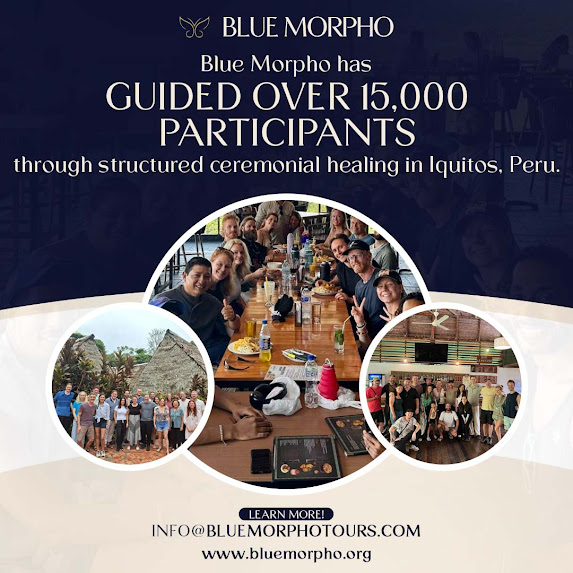
The center, which has operated for over 24 years, recently published guidance outlining how its two-medicine approach works and why the sequence matters for lasting healing outcomes.
A Structured Approach to Ceremonial Healing
Blue Morpho in Peru sits on a 170-acre private reserve in the Amazonian rainforest near Iquitos. Built in 2006, the lodge was among the first shamanic healing centers in the region to open its doors to international participants. Today, it has served people from more than 100 countries.
The retreat operates on a model that pairs two distinct traditional medicines: one from the Amazon and one from the Andes, used in sequence across the retreat program. The logic behind this sequencing is not new. It draws from indigenous healing traditions that have long recognized how different medicines address different layers of human experience.
The Amazonian healing ceremony takes place at night, inside a custom maloca, a traditional ceremonial structure, built for ceremonial work. The Andean healing ceremony takes place during the day, often in natural outdoor settings. Each medicine is prepared by hand on-site and is administered on separate days, with rest and integration time built into the schedule.
How the Two-Medicine Model Works
The Andean Ceremony: Opening the Heart
The Andean tradition at Blue Morpho Retreats uses a sacred cactus preparation that has been part of indigenous healing ceremonies in Peru for at least 3,000 years. Archaeological records trace its use to the Cupisnique culture as far back as 1500 BC.
Participants widely describe the daytime ceremony as grounding and emotionally opening. It tends to create a sense of warmth, belonging, and connection; qualities that practitioners say prepare the emotional body to engage with deeper ceremonial work.
The Amazonian Ceremony: Going to the Root
The nighttime Amazonian ceremony works differently. Where the Andean ceremony is expansive, the traditional Amazonian healing experience tends to be inward and often intense. Research indexed on the NIH's PubMed database has found that this form of psychedelic healing produced long-term improvements in clinically depressed patients, with measurable reductions in depression scores observed at one day, one month, and one year after the ceremony.
A separate NIH-indexed review found that traditional Amazonian shamanic healing showed promise for enhancing self-acceptance and providing a pathway for individuals dealing with trauma, PTSD, and substance use recovery.
Daily Integration: What Makes It Last
Blue Morpho tours are structured to include daily integration sessions with Maestro Hamilton Souther. Practitioners and researchers increasingly recognize integration as a key factor in whether ceremonial healing produces lasting change. Daily integration sessions typically include:
Morning Q&A with Maestro Hamilton
One-on-one reflection time after each ceremony
Guided journaling and dietary support
Community sharing within the group
The Lineage Behind the Work
Blue Morpho, founded by Hamilton Souther, carries a credential that is rare in the global psychedelic healing space. Souther is a trained anthropologist and a graduate of the University of Colorado Boulder. He apprenticed under Don Julio Llerena Pinedo in the Peruvian Amazon and became the first Westerner ever formally recognized as a Maestro Medico Vegetalista, a title granted through traditional indigenous lineage, not through a training course or certification program.
Souther has conducted over 1,500 traditional Amazonian healing ceremonies and has worked with more than 15,000 participants from over 100 countries across his 24-year practice. His work has been reported by TIME, The New York Times, National Geographic, The Washington Post, and NPR.
His approach to psychedelic healing emphasizes safety protocols, small group sizes, detailed health screening, and what he describes as lineage-based facilitation: meaning the methods used in ceremony are drawn from traditional indigenous practice rather than adapted from modern therapeutic frameworks.
What the Research Reflects
Research on psychedelic healing continues to highlight the therapeutic potential of traditional ceremonial practices. A peer-reviewed PMC study found that mescaline was linked to self-reported improvements in depression, anxiety, PTSD, and substance use disorders in 68 to 86 percent of participants, while also showing low abuse potential. These findings do not validate any single retreat center, but they do reflect growing medical and scientific interest in traditional shamanic healing as part of the broader psychedelic renaissance.
About Blue Morpho

Blue Morpho in Peru is a ceremonial healing center founded in 2002, set on a 170-acre private reserve near Iquitos in the Peruvian Amazon. Led by Maestro Hamilton Souther, who has more than 24 years of experience in Amazonian and Andean shamanic healing, the center offers tours through small-group retreats, facilitator training, and a virtual community program for past participants.
For more information, visit the website or contact the center at 0051-931-848-983 or info@bluemorphotours.com.


Contact Information:
Blue Morpho
Office Guardia Civil 515
Iquitos, Loreto 16007
Peru
Hamilton Souther
+51 931 848 983
https://bluemorpho.org/